
Most people who live with frequent headaches can tell you roughly how bad last week was. Very few can tell you how many headache days they had last month, what they took for each one, or what usually happened the night before. Memory is a poor record keeper, especially when you are in pain. A headache diary fixes that. It turns a blur of bad days into something you and your doctor can actually read.
This guide covers what to record, how to keep the habit going when life gets busy, and how to turn a few weeks of entries into decisions you can act on.
Why a headache diary works
Headaches rarely have a single, obvious cause. They tend to show up when several things stack on the same day: a short night, a skipped lunch, a stressful deadline, a change in the weather. You notice the pain, but the build-up happens quietly over the previous day or two. Without a record, you are left guessing, and guesses tend to latch onto whatever happened most recently.
A diary helps in three ways. It shows you how often headaches really happen, which is often more or less than you think. It reveals the conditions that tend to come before your worst days. And it gives a doctor the information they need for a diagnosis and treatment plan. The Migraine Trust, a UK charity, recommends a diary for exactly these reasons: it helps your doctor make a diagnosis, helps you recognize triggers and warning signs, and shows whether a treatment is working.1
What to record every day
The most useful diary is one you will still be keeping in two months. That means recording a small set of things consistently rather than everything occasionally. Start with these:
- Headache or no headache. Log headache-free days too. They are the comparison that makes patterns visible.
- Start time and how long it lasted.
- Severity on a 0–10 scale, or simply mild, moderate or severe.
- Other symptoms, such as nausea, sensitivity to light or sound, or aura.
- Medication: what you took, when, and whether it helped.
- Sleep: roughly when you went to bed and woke up.
On a headache day, add a short note about the hours before it started: meals, caffeine, screen time, stress, alcohol or anything unusual. The six to eight hours before an attack are often the most revealing. If you menstruate, note where you are in your cycle, since hormonal changes are a common pattern for migraine.
That is enough to start. You can always add detail later, but a long list on day one is the fastest way to stop by day ten.
How to keep the habit going
Consistency matters far more than detail. A two-line entry every day beats a perfect entry once a week, because gaps make patterns unreliable. A few things help:
Log at the same time every day. Pick an anchor you already have, like brushing your teeth at night. A short evening entry captures the whole day while it is still fresh.
Make headache-free days fast. If nothing happened, the entry should take ten seconds. Save longer notes for headache days or days that felt unusual.
Write it down during the attack if you can. Start time and severity are easy to forget once the pain is gone. One quick note in the moment is enough; you can fill in the rest later.
Don't change everything at once. It is tempting to overhaul sleep, caffeine and screen time in the first week. Resist it. Keep your routine as it is for the first one to two weeks so you have an honest baseline to compare against.
Whether you use paper or your phone is a matter of what you will actually keep up with. We compare the two in paper diary or an app. Whichever you choose, the format matters less than the daily habit.
Your first two weeks
Treat the first fourteen days as a baseline. Record honestly and change as little as possible. At the end, count three things: how many headache days you had, how many were moderate or severe, and how many days you took pain relief.
Those three numbers are your starting point. Every change you try afterwards can be compared against them. Without a baseline, it is very hard to tell whether a new routine helped or whether you just had a quieter week.
How to read your patterns without fooling yourself
After a few weeks, you will start to notice things. Some will be real; some will be coincidence. A few rules keep you honest:
Look for repeats, not single events. One headache after red wine proves little. Headaches on four of the five days you slept under six hours is worth paying attention to.
Check the days without headaches too. If you slept badly on plenty of headache-free days as well, short sleep may not be the main factor. Patterns only mean something when you compare both sides.
Expect combinations. Many people find their bad days come from two or three factors together rather than one. A short night alone might be fine; a short night plus a skipped meal plus a long screen day might not. Our guide to headache triggers goes deeper into separating real triggers from coincidences.
Change one thing at a time. When you test a change, such as a regular bedtime, keep everything else as steady as you can for two to three weeks. If you change three things at once and your headaches improve, you will not know which one helped.
Common areas worth watching include sleep and headaches, skipping meals, stress headaches, caffeine, screen headaches, weather headaches and strong smells like perfume headaches. Some patterns follow your calendar, like weekend headaches, headaches at work and travel headaches. If your headaches tend to be there when you wake up, our guide to morning headaches covers the overnight causes.
Track your medication carefully
Medication is one of the most important things to record, and one of the most commonly forgotten. Note every dose, including over-the-counter painkillers, and how well each one worked. Note what you tried without medicine too, like rest in a dark room or one of the headache caps many people keep in the freezer, so you can see what really helps.
This matters for two reasons. It shows your doctor which treatments help. And it can reveal a pattern you might not notice otherwise: taking pain relief too often can itself cause more frequent headaches. Doctors call this medication overuse headache. Under the international classification of headache disorders (ICHD-3), the threshold is regular use on 15 or more days a month for simple painkillers such as paracetamol (acetaminophen), or 10 or more days a month for triptans, opioids and combination painkillers, for more than three months.3 A diary makes it easy to see if you are getting close. If you are, talk to your doctor before changing anything yourself.
A weekly review that takes ten minutes
Once a week, look back over the last seven days and answer four questions:
- How many headache days were there, and how severe?
- How many days did I take medication?
- What did the worst days have in common?
- What is one thing I will try or keep doing next week?
Write the answer to the last question down. One small, specific action ("lunch before 1 pm on workdays") is far more useful than a long list of good intentions. Once a month, compare your totals with your baseline to see the bigger trend.
Using your diary with your doctor
A diary is most valuable when it reaches your doctor or headache specialist. Before an appointment, prepare a short summary rather than handing over pages of notes: your number of headache days per month, how many were severe, how often you used medication and what worked, and the two or three patterns you have noticed. Bring the full diary in case they want detail.
This turns a vague conversation ("I get a lot of headaches") into a specific one, and helps your doctor judge whether a diagnosis or treatment needs to change.
When not to wait for patterns
A diary is for understanding recurring headaches. It is not a reason to delay care. Get urgent medical help if a headache starts suddenly and is extremely severe, follows a head injury, or comes with weakness or numbness, trouble speaking, confusion, a seizure, loss of vision, or a high fever with a stiff neck or rash.2 See a doctor soon if your headaches change in character, get steadily worse, or start after age 50. Our guide on what to do when a headache starts covers these warning signs in more detail.
Getting started
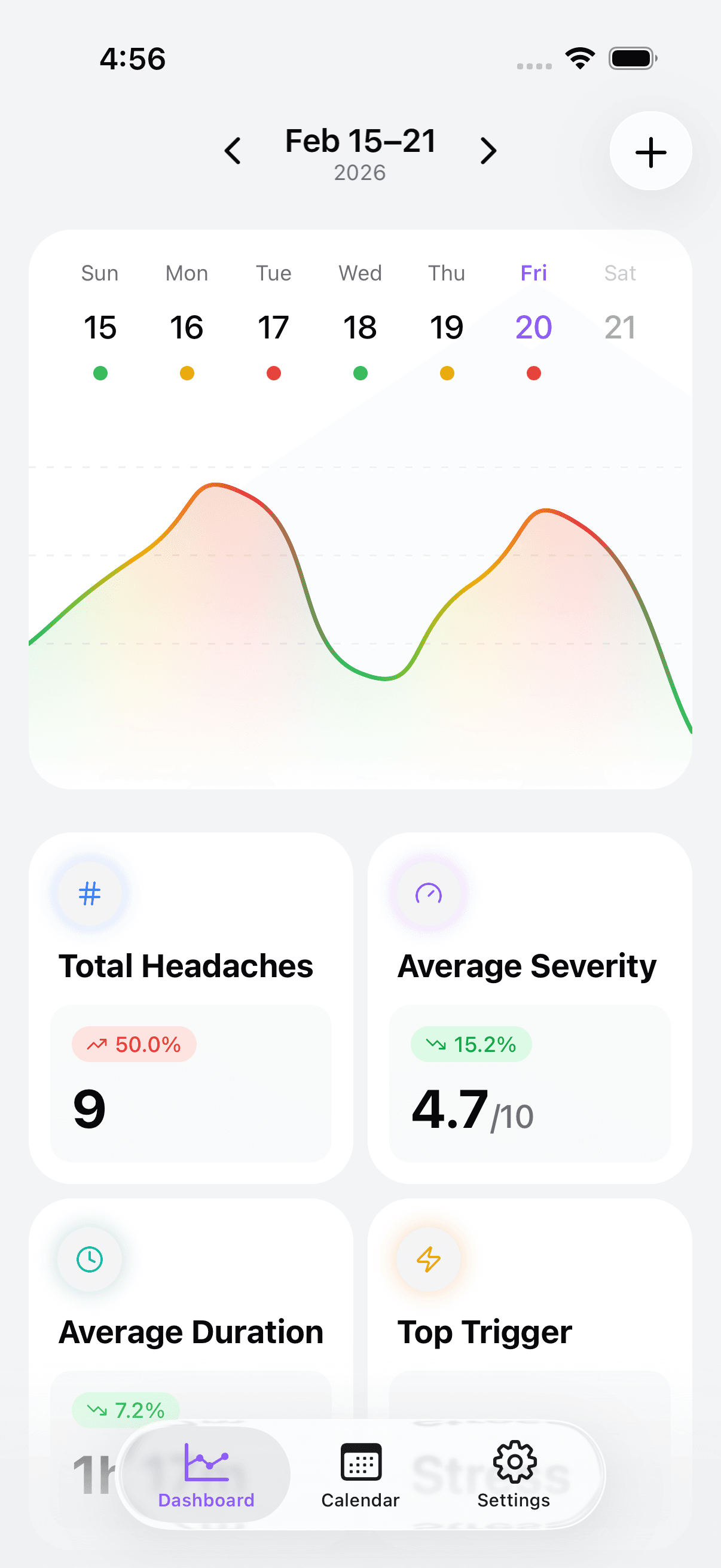
You don't need a perfect system to begin. Record today, whether or not you have a headache, and keep going for two weeks before drawing conclusions. If you prefer to use your phone, Headache & Migraine Diary lets you log a headache in seconds, with its severity, triggers and medication, and shows your headache days on a calendar so patterns are easier to spot. A notebook works too. What matters is that you keep it up.