
A coworker walks past in a cloud of perfume, or you step into a freshly cleaned room, and within minutes your head starts to pound. Perfume headaches are easy to brush off as "just a smell", but they're real and well documented, especially for people who get migraine.
This guide explains why fragrance can trigger headaches, which products people most often react to, how to tell a scent trigger from an early sign of migraine, and practical ways to reduce your exposure at home and at work.
How common are fragrance headaches?
More common than most people think. A 2020 study surveyed nationally representative samples of 4,435 adults in the United States, Australia, the United Kingdom and Sweden. On average, 12.6% said they get migraine headaches when exposed to fragranced products, ranging from 8.4% in the UK to 16.1% in Sweden.2 The study relied on people's own reports, so it can't prove the products caused every headache, but it shows how many people notice the link.
Among people who already have migraine, smell matters even more. A 2025 review that pooled 58 studies found that nearly half of people with migraine (47.8%) reported osmophobia, meaning a strong aversion to or intolerance of smells, and about 40% said odors triggered their attacks. Perfume was the most commonly named trigger.3 The Migraine Trust lists odors alongside bright lights and noise as frequently reported migraine triggers, and notes that they can also make an attack worse once it has started.1
Which scents cause the most trouble?
Perfume is the classic example, but it's far from the only one. In the four-country survey, people who got migraine from fragrance most often blamed being near someone wearing a fragranced product (53.7%), followed by air fresheners and deodorizers (43.2%), and rooms cleaned with scented products (39.9%). Some even reacted to the smell of laundry products coming from a dryer vent.2
Other common sources include scented candles and diffusers, hair and nail salons, car air fresheners, cigarette smoke, and strong-smelling paint or cleaning chemicals. Part of what makes fragrance hard to avoid is that it's added to so many everyday products. The US Job Accommodation Network points out that fragrance ingredients don't have to be listed on labels, and that even some products sold as "unscented" or "fragrance free" contain botanical oils.4
Trigger or warning sign?
This is the tricky part. The Migraine Trust explains that many people become more sensitive to light, noise and smells during a migraine attack, and even in the warning stage before the pain starts. That makes it hard to know whether a smell triggered the attack or whether you noticed the smell because an attack was already on its way.1
It also helps to know that triggers rarely act alone. The Migraine Trust describes a "threshold" idea: one factor on its own may not set off an attack, but two or three together, such as a skipped meal, a short night and a stressful day, can push you over.1 That's why the same perfume can be fine one day and unbearable the next. If you slept badly, you may be closer to your threshold before the smell ever reaches you. Our guide to sleep and headaches explains why that one matters so much.
Fragrance can also cause irritation or allergy-type symptoms. Besides headaches, the Job Accommodation Network lists watery or burning eyes, sneezing, a runny nose, congestion, skin irritation and, for some people, wheezing or worse asthma.4 If your reaction is mainly in your nose, eyes, skin or chest, mention that to your doctor, because it may need different treatment from a headache disorder.
How to cut down your exposure
You can't make the world scent-free, and trying to avoid every smell can take over your life. The Migraine Trust warns that focusing too much on avoiding triggers can cause more harm than good, and that general habits like regular sleep, meals and stress management are often more worthwhile.1 The aim is to deal with the exposures that matter most to you.
At home, start with the products you use every day: laundry detergent, fabric softener, hand soap and surface cleaners. Switch one at a time to an unscented version, so you can tell which change made a difference. Skip plug-in air fresheners, candles and diffusers, and open windows while you clean and for a while afterwards.
Out and about, give yourself an easy exit. Sit near a door or window in meetings and restaurants, step outside for fresh air when a smell hits, and choose open-air spaces when you can. Some people find a well-fitting mask helps for short exposures, such as a crowded train, though it isn't comfortable or effective for everyone.4
With family and friends, be specific rather than general. "Your perfume gives me headaches; could you skip it when we're in the car together?" is easier to agree to than "I can't stand fragrance."
When symptoms start, move away from the smell as soon as you can rather than waiting it out. If you have migraine and a treatment plan, take your medication early, as your doctor has advised.
Getting support at work
Shared offices are often where fragrance is hardest to escape. In the four-country survey, 30.6% of people who got migraine from fragranced products said they'd lost workdays or a job in the past year because of exposure at work.2
It's reasonable to ask for changes. The Job Accommodation Network describes three main options for employers: remove the fragrance where possible (for example, scented air fresheners or cleaning products), move the employee away from it, or reduce their exposure with a private or better-ventilated space.4 In the UK, The Migraine Trust explains that migraine may count as a disability if it has a substantial, long-term effect on your daily life, in which case your employer must make reasonable adjustments, such as fixing problems with ventilation.5 Rules differ between countries, but small requests, like a desk away from the kitchen or bathroom air freshener, are often easy to grant. Our guide to headaches at work covers other workplace triggers and how to raise them.
Find your own pattern
Because smells are so often bound up with other triggers, a headache diary is the best way to work out how much fragrance really affects you. For a few weeks, note any strong smell before a headache: what it was, where you were, and how long you were exposed. Also record the basics, like sleep, meals and stress, and note the times you were around strong smells and didn't get a headache. That last part matters: if a smell only causes trouble on days you've slept badly, sleep may be the bigger target. Our guide to headache triggers explains how to separate real triggers from coincidences.
When to see a doctor
See a doctor if your headaches are frequent or severe, if they're getting worse, or if scent sensitivity is affecting your work or social life. Treatment for migraine, including preventive treatment, may make you less sensitive overall. If you're not sure what kind of headaches you get, our guide to tension headache vs migraine is a good place to start.
Get urgent help for a headache that starts suddenly and is extremely painful, or comes with weakness, numbness, confusion, trouble speaking, loss of vision, a seizure, or a high temperature with a stiff neck.6 Also get urgent help if a smell or fume exposure causes breathing difficulty.
Getting started
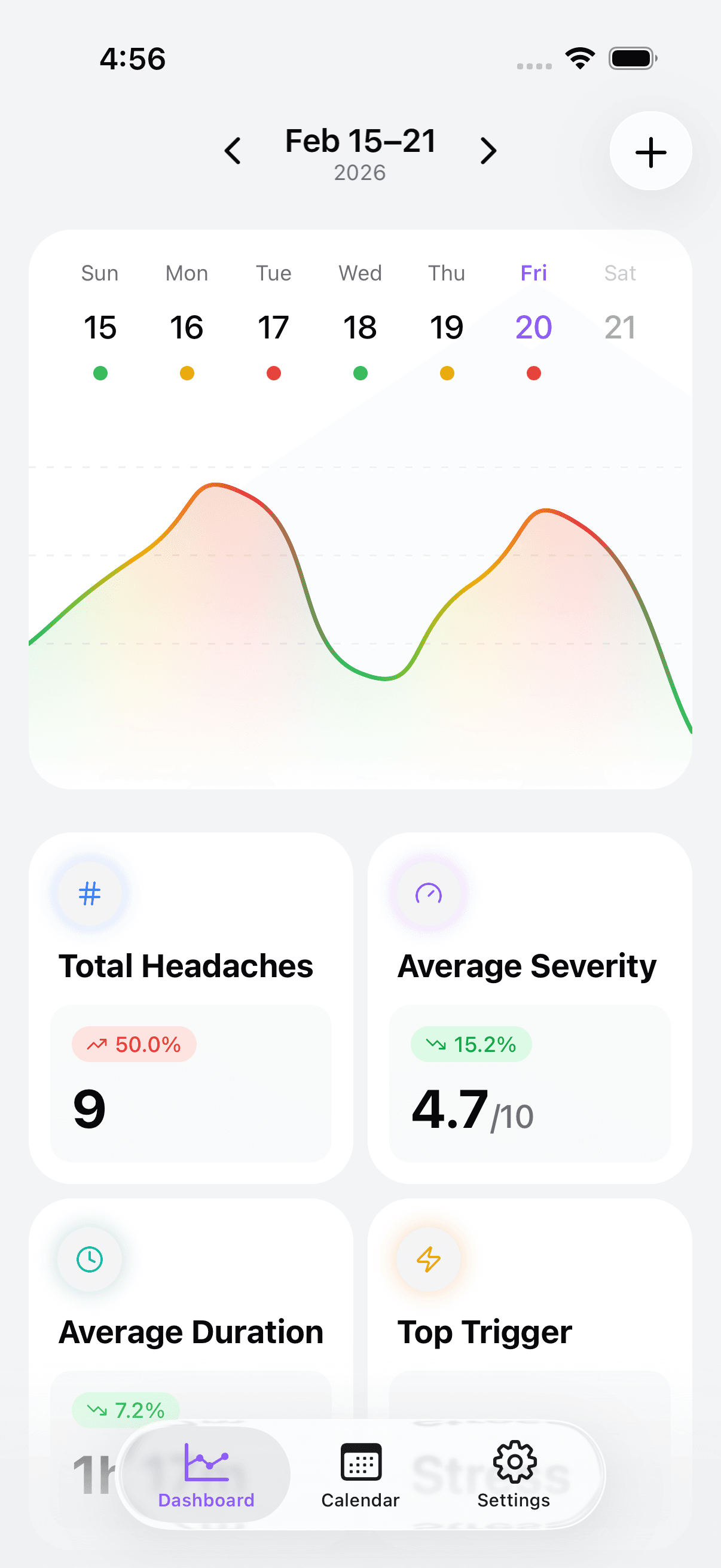
Pick the one scented product you're around most, often laundry detergent or an air freshener, and swap it for an unscented version for two weeks. To see whether it helps, Headache & Migraine Diary lets you log each headache in seconds and add a note about any strong smells, so you can look back and see whether fragrance shows up before your headache days.