
A headache diary only helps if you keep it. That sounds obvious, but it is the whole question when choosing between a notebook and a headache tracking app. The best format is not the one with the most features. It is the one you will still be filling in on a busy Tuesday three months from now.
Both can work well. This guide compares them on the things that actually affect your results: how accurate the entries are, how much effort they take, how easy they are to review, and how private they are.
Accuracy: when the entry gets written
The biggest difference between paper and an app is not the format itself. It is when people write things down.
A well-known study published in the BMJ in 2002 gave people with chronic pain either a paper diary or an electronic one and asked them to make entries at set times. The paper diaries had hidden sensors that recorded when they were opened. People using paper reported filling in their diary on time 90% of the time, but the sensors showed the real figure was 11%. Many entries were written later in a batch, sometimes for days when the diary was never opened at all. The electronic diary group, whose entries were time-stamped, completed 94% of their entries on time.1
That doesn't mean paper users are careless. It means memory fills in the gaps, and remembered entries are less reliable than ones written in the moment. For headaches, that matters: the start time, severity and what you took are easy to get wrong a day later.
The practical lesson works for either format. Write the entry close to when it happens. If you use paper, keep the notebook somewhere you'll see it. If you use an app, a reminder at a set time does the same job.
Effort: what it takes to keep going
Paper has almost no setup. A notebook, a pen and a simple layout are enough, and writing by hand can feel calmer than another screen. It is also flexible: you can sketch, scribble a long note, or record something no app has a field for.
The cost shows up later. Paper entries take longer to review, totals have to be counted by hand, and the notebook has to be with you when a headache starts.
An app takes a minute to set up but is usually faster day to day. Tapping a severity and picking from a list of triggers is quicker than writing them out, especially during an attack. Apps can also remind you to log, which helps more than people expect: a small study of headache patients in The Journal of Headache and Pain found good compliance with an electronic diary, and most participants found it handier than the paper version.2
If you have tried a diary before and stopped after a week, the reason is usually effort. Pick the format that makes a single entry quickest for you.
Reviewing your data: spotting patterns
A diary pays off when you look back at it. This is where the two formats differ most.
With paper, you review by flipping through pages and counting. It works, but it takes discipline, and it is easy to miss a slow trend, like headache days creeping up over two months. A simple monthly tally at the back of the notebook helps a lot.
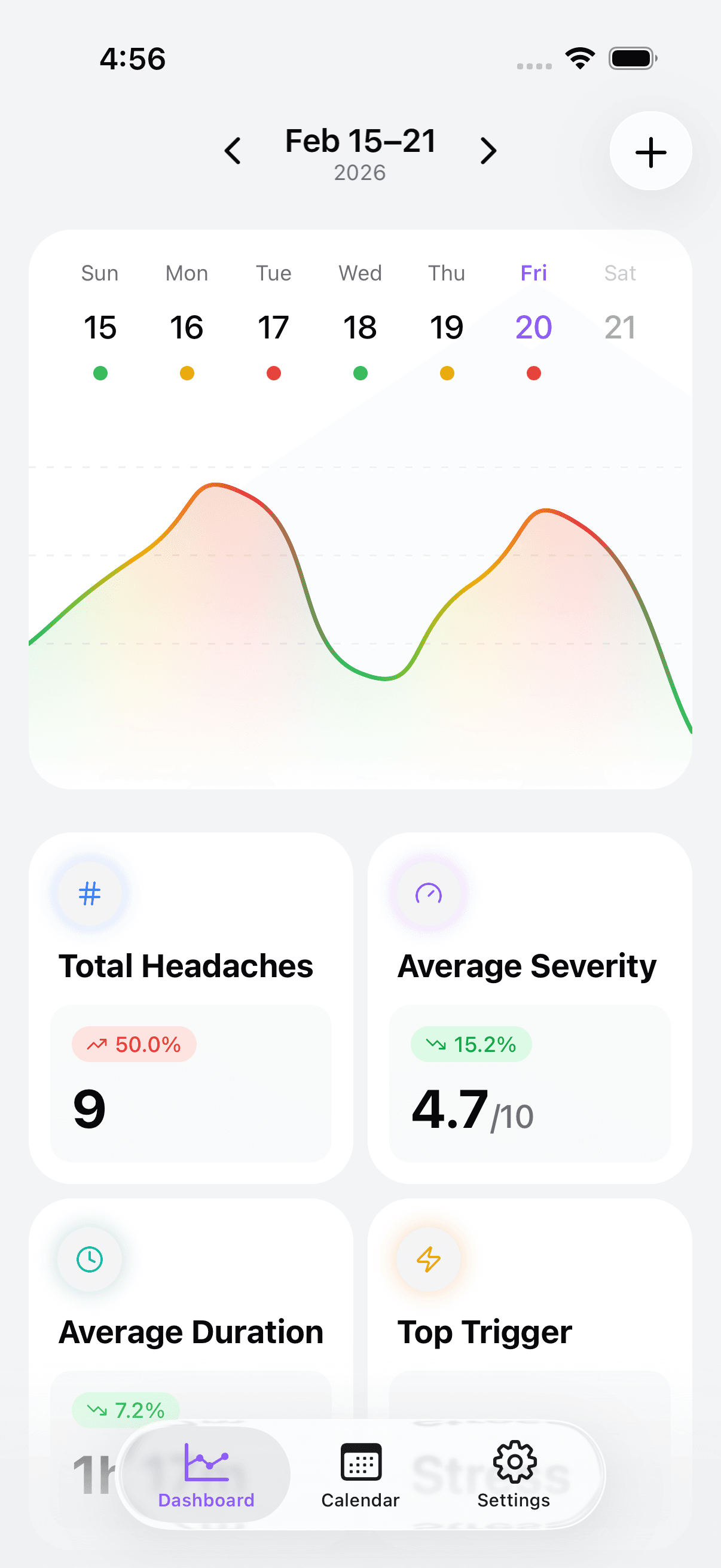
An app does the counting for you. It can show headache days on a calendar, track how often you took medication, and make it easier to see whether certain headache triggers keep showing up before your worst days. That automatic counting matters most for medication: taking pain relief too often can lead to medication overuse headache, and a running count is much easier to see in an app than in a notebook.
Whichever you use, set aside ten minutes a week to look back. A diary nobody reviews is just a list.
Privacy
Paper is fully private as long as you keep it somewhere safe. Nothing leaves the notebook.
Apps vary widely, so check before you choose one. Look at where your data is stored, whether you need to create an account, and whether the app shares data with advertisers or analytics companies. Health data is personal, and you should be comfortable with the answer.
Headache & Migraine Diary, for example, doesn't require an account. Your logs are stored on your phone, and on iPhone they can sync through your own iCloud, which we can't access. You can read the details in our privacy policy.
Sharing with your doctor
Doctors find a diary most useful when it is summarized: how many headache days you had each month, how severe they were, what you took and what helped. Paper diaries can be photocopied or brought along, but you'll usually need to prepare the summary yourself. With an app, the calendar and totals are already there to show on your phone during the appointment.
Either way, bring the summary rather than expecting your doctor to read every entry.
Which should you choose?
Choose paper if you like writing by hand, want complete privacy, prefer free-form notes, or find phones distracting. Keep it short, keep it visible, and do a monthly tally.
Choose an app if you want quick entries during an attack, reminders to log, automatic totals and a calendar view of your headache days.
You can also combine them. Some people log the basics in an app and keep a notebook for longer reflections or for questions to ask their doctor.
The honest answer is to try one for two weeks. If you are still logging at the end, you have found your format. If not, switch. What matters is a consistent record, not the tool you used to make it.