A sudden, sharp jolt shoots up from the base of your skull, like an electric shock under the scalp. It might last only a few seconds, but it keeps coming back, and afterwards even brushing your hair or resting your head on a pillow can hurt. Pain like this at the back of the head is often caused by occipital neuralgia, a problem with the nerves that run from the top of the neck into the scalp.
Occipital neuralgia is easy to confuse with migraine and other headaches, and the two often happen together. This guide explains what occipital neuralgia is, the symptoms that set it apart, what causes it, how doctors diagnose and treat it, and the warning signs that need urgent care.
What is occipital neuralgia?
Most of the feeling in the back and top of your head travels to the brain along the two greater occipital nerves, one on each side. They come out between the bones of the spine in the upper neck, pass through the muscles at the back of the head and spread into the scalp, sometimes almost as far forward as the forehead.2 There are also smaller lesser and third occipital nerves in the same area.4
"Neuralgia" means nerve pain. Occipital neuralgia happens when one or more of these nerves is irritated, inflamed or squeezed, so it sends pain signals along its path.12 That's why the pain follows the course of the nerve, from the base of the skull up over the scalp, rather than spreading across the whole head.
Occipital neuralgia symptoms
The pain usually starts at the back of the head or the base of the skull, on one side or both. It can also shoot forward towards the eye on the same side.12 People describe it as:1
- sudden, sharp, shooting or piercing
- like an electric shock
- burning or aching
- throbbing
Other common signs include a scalp so sensitive that washing your hair or lying on a pillow becomes hard, numbness in the affected area, and tenderness where the nerve comes up into the scalp near the base of the skull.2 Turning your head or pressing on that spot can set the pain off.3
The headache classification doctors use (ICHD-3) describes the typical pattern as attacks of severe, shooting or stabbing pain that last from a few seconds to a few minutes, with tenderness over the nerve and pain or odd sensations when the scalp or hair is touched lightly.4 Cleveland Clinic notes that for some people the pain lasts hours rather than seconds, and that it can become long-lasting.1
Occipital neuralgia vs migraine
Pain at the back of the head is also a common migraine symptom, so telling the two apart can be tricky, even for doctors.3 Some differences can help:
- The type of pain. Occipital neuralgia tends to be brief, sharp and shooting, in bursts. Migraine pain usually builds up and throbs for hours.
- Other symptoms. Migraine often comes with nausea and sensitivity to light. Neck or back-of-head pain without those symptoms may point to occipital neuralgia instead.3
- Triggers. Occipital neuralgia can be set off by moving your neck or by touching a tender spot on the scalp.34
The two also overlap. Johns Hopkins Medicine says true occipital neuralgia on its own is quite rare, and that migraines which keep affecting the back of the head on one side can irritate the greater occipital nerve and blur the picture.2 The American Migraine Foundation adds that it's uncommon for someone to have only occipital neuralgia; it's often found while a person is being checked for migraine, and sometimes doctors only learn which problem is driving the pain by treating both.3
Tension-type headache can also cause a band of pressure that reaches the back of the head. Our guide to tension headache vs migraine explains how those two differ.
What causes occipital neuralgia?
The most common causes are a pinched nerve or tight neck muscles that trap the nerve.12 Other causes include:
- a pinched nerve root in the neck, for example from arthritis in the upper spine2
- a head or neck injury1
- earlier surgery or injury to the scalp or skull2
Cleveland Clinic lists several conditions that make occipital neuralgia more likely: degenerative disk disease, osteoarthritis of the upper spine, diabetes, gout and inflammation of the blood vessels (vasculitis).1 Sometimes it starts with no clear cause at all.2
Because tight neck muscles can make the pain flare, long hours in one position may matter too. If your pain is worse after a day at a desk, our guide to desk job headaches has practical posture and break tips.
How occipital neuralgia is diagnosed
There's no single test for occipital neuralgia.12 A doctor, often a neurologist, will ask about your pain and examine your head and neck, pressing along the occipital nerve to look for tenderness.2
A key test is an occipital nerve block: an injection of numbing medicine near the nerve. If the pain eases for a while afterwards, that supports the diagnosis, and it gives you some relief at the same time.24 Your doctor may also order a CT or MRI scan to look at your spine.1
Occipital neuralgia treatment
Treatment aims to calm the irritated nerve and ease the pain. Most people improve with treatments that don't involve surgery.1
Self-care and physical treatments. Cleveland Clinic lists heat on the area, massage and physical therapy.1 The American Migraine Foundation says regular exercise, stretching and yoga can make a big difference, and suggests starting them even before you see a doctor.3
Stretches. Gentle neck stretches and massage can loosen tight neck muscles that make flares worse. Cleveland Clinic suggests chin tucks a few times a week: stand with your back against a wall, slowly tuck your chin towards your chest and draw your head back to the wall, and hold for 5 to 10 seconds. Stop and see your doctor if an exercise makes the pain worse.1
Medicines. A doctor may prescribe anti-inflammatory painkillers, muscle relaxants, or anticonvulsants (medicines that calm overactive nerves).1 If simpler steps don't work, daily preventive medicine may be needed.3 Talk to your doctor about which option suits you.
Injections. Nerve blocks with a numbing medicine and a steroid, and Botox injections, can calm the nerve.12 The effect of a steroid injection may wear off after three to six months, so some people need repeat treatment.1
Surgery and nerve stimulation. When nothing else works, options include occipital nerve stimulation or spinal cord stimulation, where electrodes block pain signals, and occipital release surgery, which frees the nerves from the tissue squeezing them.12 These are reserved for pain that hasn't responded to other treatments.
How long does occipital neuralgia last?
Each attack may last only seconds or minutes, or occasionally hours.14 How long the condition itself lasts depends on the cause and treatment. For mild to moderate pain, Cleveland Clinic says people may feel better after a week or two of treatment; for more intense pain it can take four to six weeks to notice an improvement.1 Occipital neuralgia isn't life-threatening, and once the nerve heals the pain usually goes away, although some people need to keep stretching or taking medicine to stop it coming back.1
When to get medical help
See a doctor if you have repeated sharp pain at the back of your head, if it isn't getting better with self-care, or if you get headaches regularly.5 A tender scalp can have other causes too: the NHS advises an urgent appointment if you have a headache with jaw pain when eating or a sore or tender scalp, or a headache made worse by coughing, sneezing or bending down.5
Cleveland Clinic says occipital neuralgia is usually not an emergency, but head or neck pain needs immediate care if it comes with fever, vision problems, weakness, numbness, trouble speaking or sudden confusion.1 Call your local emergency number or go to an emergency department if you have a headache and:15
- it started suddenly and is extremely painful
- a very high temperature, a stiff neck, or bright light bothers you
- numbness or weakness in your face or body
- loss of vision or double vision
- difficulty speaking, balancing, walking or remembering things
- drowsiness or confusion
- a head injury in the last three months
- a seizure
Our guide on when a headache needs urgent care covers these warning signs in more detail.
What to do next
Because occipital neuralgia and migraine look so alike, a clear record of your attacks is one of the most useful things you can bring to a doctor. For each episode, note where the pain started and where it spread, whether it was a brief shock or a long throb, how long it lasted, what set it off (turning your head, touching your scalp, a long day at a screen), and whether nausea or light sensitivity came with it. Over a few weeks this shows a pattern that's hard to describe from memory, and it can help you spot headache triggers such as stress or posture.
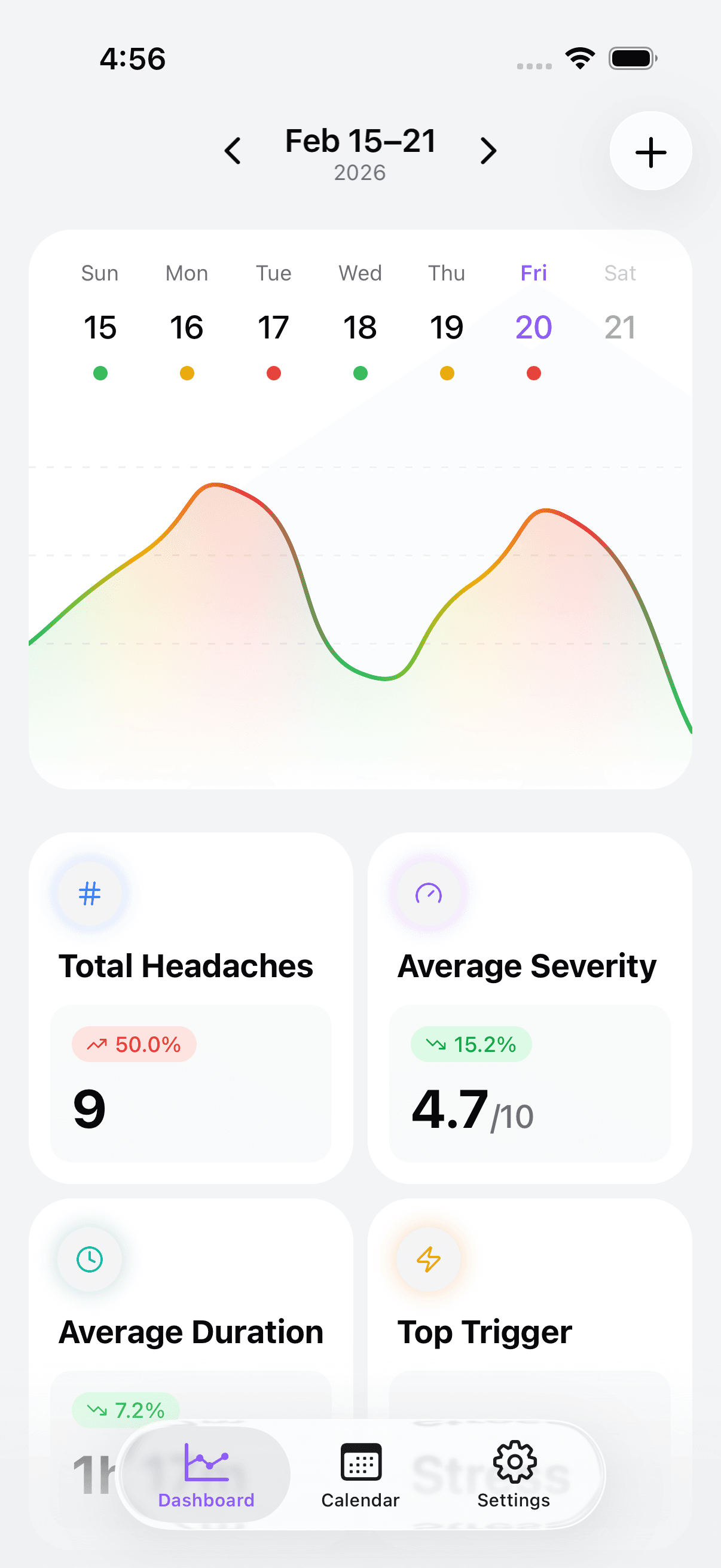
A headache diary can be paper or an app. Headache & Migraine Diary lets you log each headache's type, location, severity and duration, tag possible triggers such as stress, lack of sleep or screen time, record the medicines you took, and review patterns in the calendar and stats. Bring your records to your appointment so your doctor can see how your pain behaves over time.