Quick answer: Chronic migraine is headache on 15 or more days a month for more than three months, with the features of migraine on at least 8 of those days.1 It often develops gradually as migraine attacks become more frequent, and treatment usually combines medicine with lifestyle changes.2 If you have headache on 15 or more days a month, speak to your doctor.2
Most people with migraine get attacks now and then, with clear days in between. For some, the gaps slowly shrink until there are more headache days than clear ones. At that point the bad days start to blur together, and it gets hard to say how many attacks you've had this month, or where one ended and the next began.
That pattern has a name, chronic migraine, and a precise definition that depends on counting days. This guide explains what the definition is, what the symptoms look like, why migraine becomes chronic, how doctors treat it and what the outlook is.
What chronic migraine is
Doctors sort migraine into two groups by how often it happens. The International Classification of Headache Disorders (ICHD-3) defines chronic migraine as headache on 15 or more days a month for more than three months, where at least 8 days a month have the features of migraine.1 With fewer than 15 headache days a month, it is called episodic migraine.2
Two details of the definition surprise people. First, not every headache day has to be a migraine day. Milder days that feel more like a tension headache count toward the 15 as well, so the difference between a tension headache and a migraine matters less here than the total.1 Second, chronic migraine isn't a separate kind of migraine. The Migraine Trust says it can apply to any type, including migraine with or without aura and vestibular migraine.2
Chronic migraine symptoms
The symptoms are the same as those of episodic migraine. They simply happen more often or last longer.3 The Migraine Trust lists these:2
- frequent headache
- increased sensitivity to light, sound or smells
- feeling sick or being sick
- eyesight changes, including seeing patterns, colors or lights
- difficulty with speech
- numbness
- dizziness
The eyesight changes, speech difficulty and numbness on that list are typical of a migraine aura. What sets chronic migraine apart is how the days run together. ICHD-3 notes that with headaches this frequent, the character of the pain can change from day to day and even within the same day, which makes it impossible to pick out individual attacks.1 Cleveland Clinic describes the same thing: symptoms can shift daily, or even hour to hour, so it's hard to tell where one headache ends and another begins.3
What causes chronic migraine
It isn't fully understood why some people get chronic migraine. It often develops gradually, with attacks becoming more frequent over time, and the Migraine Trust says around 3% of people with episodic migraine develop chronic migraine each year.2 Cleveland Clinic calls this shift migraine transformation.3
Several conditions and lifestyle factors are associated with it. The Migraine Trust's list includes depression and anxiety, other pain conditions such as fibromyalgia, sleep apnea, obesity, high stress levels, and overuse of acute migraine medicine.2 Cleveland Clinic adds head injuries such as concussion.3 Some of these work in both directions: depression can play a role in migraine becoming chronic, and living with chronic migraine can also be a cause of depression.2
Managing these factors can sometimes reduce how often attacks come, though not all of them can be improved or prevented, even with the right support.2 That is one reason doctors ask about sleep and headaches together, and about mood and stress, when migraine gets more frequent.
Medication overuse and chronic migraine
The factor doctors look at first is how often you take pain relief. When you're in pain on most days, it's natural to take something on most days, and that can backfire. The Migraine Trust says up to 7 out of 10 people with chronic migraine may also have medication overuse headache, a daily headache that develops when acute medicines are taken on too many days of the month. On average, it gives these thresholds:2
- paracetamol (acetaminophen) or anti-inflammatory painkillers such as ibuprofen and naproxen on 15 or more days a month
- triptans, ergotamine, opioids such as codeine, or combination painkillers on 10 or more days a month
ICHD-3 goes further and calls medication overuse the most common cause of symptoms that look like chronic migraine. It notes that around 50% of people who appear to have chronic migraine go back to an episodic pattern once the overused medicine is withdrawn.1
Don't cut back on your own. If you regularly take painkillers and still have daily headaches, speak to your doctor, who can help you reduce them, for example by starting a preventive treatment or changing your acute medicine.2
How chronic migraine is diagnosed
There is no standard test for episodic or chronic migraine. A doctor diagnoses it from your history, and may run extra tests to rule out other causes or refer you to a headache specialist.2
Because the diagnosis rests on counting days, a record matters more here than for almost any other headache. ICHD-3 says that working out the pattern of frequently recurring headache generally requires a headache diary that records pain and other symptoms day by day for at least one month.1 The Migraine Trust also suggests a diary to help explain the frequency and impact of your symptoms to your doctor.2
Chronic migraine treatment
Treatment usually combines several approaches, and most people with chronic migraine need medicine to manage their symptoms.2 It comes in two kinds.3
Acute medicines treat an attack once it has started. Over-the-counter painkillers such as paracetamol, aspirin or ibuprofen may help, and a doctor may prescribe a triptan if they don't. Acute medicines work best when taken as soon as the head pain starts. With pain on so many days, the hard part is deciding when to use them, and the Migraine Trust suggests saving them for your worst days if you can tell which those are. It advises avoiding painkillers that contain opioids, such as codeine, where possible.2
Preventive medicines are taken regularly to make attacks less frequent and less severe. They're often needed in chronic migraine and don't cause medication overuse headache. Options include amitriptyline, propranolol, candesartan, topiramate and newer medicines called CGRP antibodies and gepants. Which one you're offered depends on your pattern of attacks, your health history and whether you are or may become pregnant.2 Preventives are slow: it can take 8 to 12 weeks for one to work fully, and ideally you take it for at least three months before judging it. If the first one doesn't help, there are others to try.2
A specialist may also offer nerve blocks or Botox for migraines.2 In the UK, NICE recommends Botox as an option for adults with chronic migraine only after at least three preventive medicines haven't worked, and only if medication overuse is being managed.4
Some non-medicine options can help alongside medicine. The Migraine Trust mentions supplements such as riboflavin, magnesium or coenzyme Q10, acupuncture and migraine devices,2 and Cleveland Clinic lists nerve stimulation and psychotherapy for stress and anxiety.3 There is some evidence that disrupted sleep, high stress, poor diet and lack of exercise can make attacks more frequent, though not for everyone, and even small changes such as regular sleep habits or relaxation techniques can have a positive effect.2 Many people with chronic migraine find their headache triggers hard to identify until their symptoms start to improve.2
Can chronic migraine go away?
Often, yes, in the sense that it can return to an episodic pattern. The Migraine Trust says research shows between 25% and 75% of people meet the criteria for episodic migraine again within two years, with or without medical treatment. The range is wide because the studies differ.2 Cleveland Clinic gives a similar figure, 26% to 70%, and notes that some people move back and forth between episodic and chronic migraine over time.3
When to get medical help
See a doctor if you have headache on 15 or more days a month.2 More generally, the NHS advises seeing a doctor if you regularly get headaches, or if a headache isn't getting better or is getting worse after you've treated it yourself.5
Frequent migraine can make it easy to dismiss a headache that is actually different. Ask for an urgent appointment for a headache with vision or eye problems, vomiting, jaw pain when eating or a sore scalp, or one triggered or made worse by coughing, sneezing, bending down or exercising.5
Call your local emergency number or go to an emergency department if a headache started suddenly and is extremely painful (a thunderclap headache), or comes with a seizure, numbness or weakness in the face or body, difficulty speaking, balancing, walking or remembering things, drowsiness or confusion, loss of vision, a rash that doesn't fade when a glass is rolled over it, a very high temperature with a stiff neck, or a head injury in the last 3 months.5
<!-- faq -->Frequently asked questions
How many migraines a month is considered chronic?
The count is in headache days, not attacks: 15 or more headache days a month for more than three months, with migraine features on at least 8 of those days.1 Fewer than 15 headache days a month is called episodic migraine.2
How common is chronic migraine?
Cleveland Clinic says experts estimate that 1% to 2.2% of people worldwide have chronic migraine, compared with around 12% to 15% for migraine overall. It is more likely to affect women.3
Is chronic migraine a disability?
It can be very disabling. The Migraine Trust says people with chronic migraine can experience greater levels of disability than those with episodic migraine, and that it can be hard to find or keep work without a supportive employer.2 Whether it counts as a disability in law depends on the rules where you live.
Does chronic migraine cause brain damage?
The Migraine Trust says there is currently no evidence that migraine causes brain damage or memory loss. It adds that a brain scan usually isn't needed unless something is outside your normal migraine pattern, such as a sudden, agonizing headache or a new headache if you are over 50.2
Counting your headache days
If you suspect your migraine has become chronic, start by counting. For one month, record every day with a headache, mild ones included, along with the symptoms that came with it and any medicine you took. At the end of the month you'll have the numbers a doctor asks about first: how many headache days, how many of them had migraine features, and how often you took pain relief.
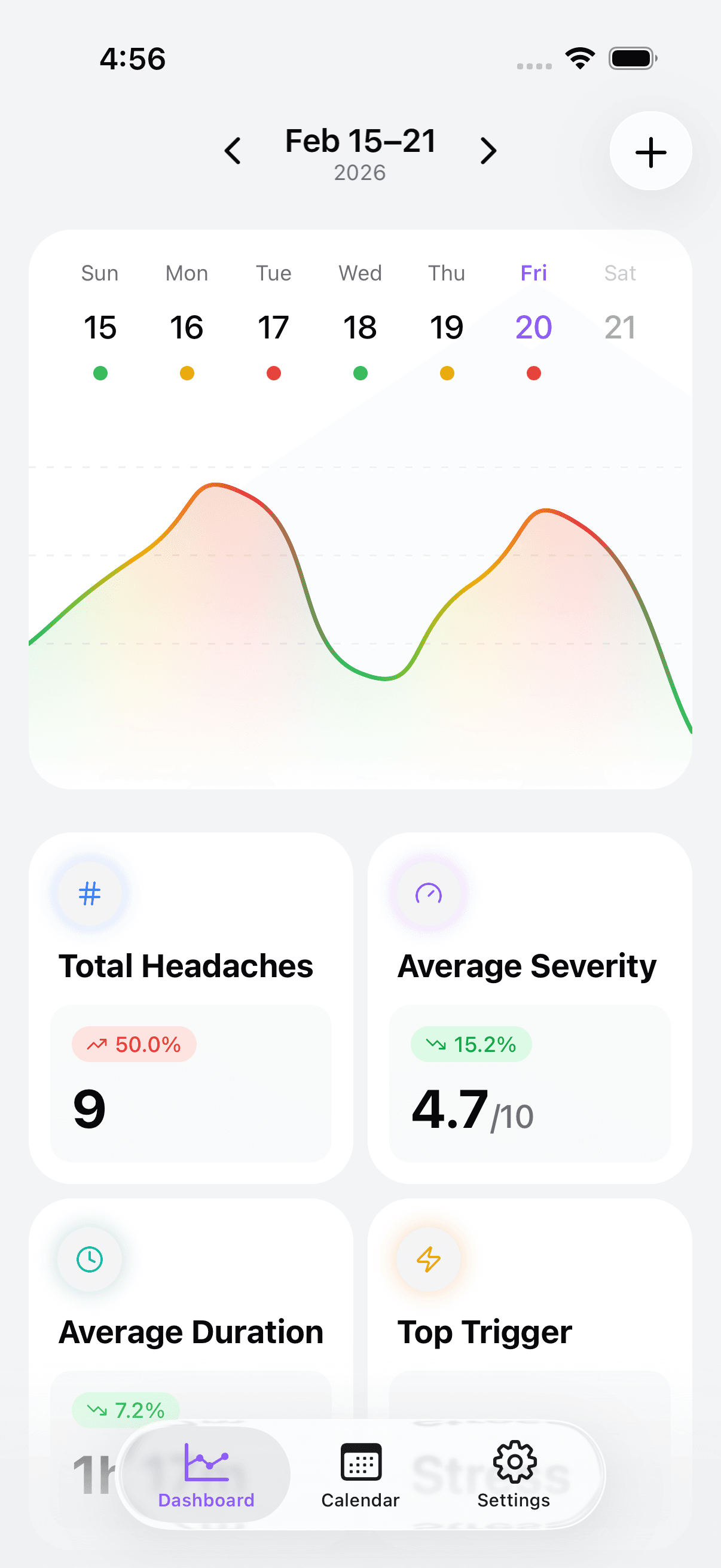
Headache & Migraine Diary lets you log each headache in a few taps, with its severity, how long it lasted, symptoms such as nausea, light sensitivity or aura, possible triggers and the medicine you took. The calendar shows which days had a headache, so the month is easy to count and to show your doctor.