If ordinary painkillers don't touch your migraine attacks, there's a good chance your doctor will suggest a triptan. Triptans are one of the most widely used treatments for migraine attacks, and for many people they turn a lost day into a manageable one. They also come with rules that are easy to miss: when to take them, how many doses are allowed, and how often is too often.
This guide explains how triptans for migraines work, the different types, how to get the most out of them, the common side effects, who shouldn't take them, and what to do if they don't help. It's general information, so your doctor or pharmacist is the right person for questions about your own medicine and dose.
What triptans are and how they work
Triptans are acute medicines for migraine. That means you take them to ease an attack that has already started, including the headache, nausea and sensitivity to light and sound. They don't prevent attacks from starting.13 Cleveland Clinic calls them a first-line treatment for migraine and describes them as "rescue" medicines rather than something you take every day.2
Their chemical name is 5-HT receptor agonists. 5-HT is serotonin, and triptans bind to serotonin receptors on the nerves that carry pain signals from your head. This reduces the pain signals and stops the release of proteins involved in migraine pain.1 Triptans also narrow blood vessels, which is the effect that led researchers to develop them in the first place, though The Migraine Trust notes this isn't thought to be what eases migraine symptoms.12
Besides migraine with and without aura, some triptans are also used for cluster headaches, usually as an injection or nasal spray.23
The different triptans
There are seven triptans, and all of their names end in "-triptan".2 Brand names vary by country.
- Sumatriptan: tablets, nasal spray and injection. It's the most prescribed and often the first one doctors try.12
- Rizatriptan: tablets and tablets that dissolve on the tongue.1
- Zolmitriptan: tablets, dissolving tablets and nasal spray.1
- Eletriptan, almotriptan, naratriptan and frovatriptan: tablets.1
They all work in a similar way but not identically. Naratriptan and frovatriptan take longer to reach their full effect but last longer, and some triptans are less likely to cause side effects than others.1 Your doctor may choose one based on how quickly your attacks build, how long they last and which symptoms you get.1 NICE, which writes clinical guidelines in England, advises starting with the lowest-cost triptan and trying one or more others if it consistently doesn't work.4
Nasal sprays, injections and dissolving tablets can work faster than tablets you swallow. They can also be a better option if you vomit during attacks and struggle to keep tablets down.1
How to take triptans
Take it early in the attack. The Migraine Trust advises taking a triptan as soon as the head pain starts.1 The NHS says sumatriptan may start to work within 30 minutes but can take up to 2 hours.3 If you get a migraine aura without any head pain, talk to your doctor: triptans aren't usually prescribed for that.1
Know the second-dose rule. If your symptoms ease and then come back, you can usually take a second dose, but not straight away. For sumatriptan tablets and nasal spray, the NHS says to wait at least 2 hours after the first dose. It also says not to take a second dose if the first one didn't help at all.3 The Migraine Trust gives a general maximum of two doses in 24 hours, and the exact limits depend on your medicine, so follow the leaflet.1
Ask about combining. NICE recommends a triptan together with an anti-inflammatory painkiller (NSAID) or paracetamol (acetaminophen) as one option for treating migraine attacks, and a triptan on its own for people who prefer one medicine.4 It also suggests considering an anti-sickness medicine alongside other treatment, even if you don't feel sick.4 Ask your doctor which combination suits you before mixing anything.
Give it a fair trial. Doctors usually suggest trying a triptan over a few weeks of attacks to see whether it works for you, and keeping a headache diary to record how often you get attacks and what you took.1
Common side effects
Many people take triptans with few problems, but side effects are possible. The most common include:123
- feeling or being sick
- dizziness, drowsiness or tiredness
- flushing
- tingling or pins and needles
- muscle aches, neck pain or weakness
If you feel dizzy or tired after a dose, the NHS advises not driving, cycling or using machinery until it passes.3 If side effects bother you, tell your doctor: switching to a different triptan can help, because some cause fewer side effects than others.1
Serious side effects are rare. Cleveland Clinic puts them at under 1% of people who take triptans.2 The NHS lists a severe allergic reaction and a heart attack (severe chest pain or tightness) as possible serious side effects of sumatriptan, which need emergency help.3 Your doctor can explain the difference between the usual harmless sensations a triptan can cause and signs of a problem.2
Who shouldn't take triptans
Because triptans narrow blood vessels, doctors don't prescribe them to people with heart or circulation problems, including anyone who has had a heart attack or stroke.1 Cleveland Clinic and the NHS also list uncontrolled high blood pressure, peripheral artery disease and a history of a mini-stroke (TIA) as reasons they may not be suitable, and the NHS adds liver and kidney conditions and seizures.23
Other points to raise with your doctor:
- Other medicines. Triptans don't mix well with some other migraine medicines (ergotamine or a second triptan), some antidepressants (SSRIs and SNRIs), lithium and St John's wort.3 Tell your doctor or pharmacist about everything you take, including supplements.
- Age. People over 65 may need a check of risks and benefits first. For 12 to 17-year-olds, sumatriptan nasal spray is the only triptan licensed in the UK, and NICE suggests a nasal triptan for this age group.14
- Pregnancy and breastfeeding. There's limited data, so doctors usually weigh the benefits against the risks. When a triptan is needed, sumatriptan is usually the one recommended, because there's more safety data for it.1
How often is too often?
This is the limit that catches people out. Taking triptans too often for too long can make headaches more frequent and more severe. This is called medication overuse headache, or rebound headache.13
The International Classification of Headache Disorders (ICHD-3) defines triptan-overuse headache as headache on 15 or more days a month that develops after taking triptans on 10 or more days a month for more than three months.5 It also notes that triptan overuse can push migraine up to the frequency of chronic migraine, and that this seems to happen sooner with triptans than with some older migraine medicines.5 Days are what count, not doses, and it usually improves once the overuse stops.5
The Migraine Trust's practical advice is simpler: try not to take acute medicines on more than two days a week.1 If you find you need a triptan more often than that, talk to your doctor rather than cutting back on your own.
What to do if triptans don't help
Triptans work well for many people, but not for everyone. If yours isn't helping, your doctor may change the dose, the form (a nasal spray or injection instead of a tablet) or try a different triptan.14 If at least two triptans haven't worked or you can't take them, there are other options, such as a newer type of medicine called a gepant.14
If you're needing acute medicine often, or it isn't working even at the maximum dose, ask your doctor about preventive treatment, which aims to cut how many attacks you get.1 For chronic migraine, NICE also lists Botox for migraines as an option once at least three preventive medicines haven't worked.4 The NHS advises seeing a doctor if your attacks are severe, getting worse, lasting longer than usual or happening more than once a week.6 If you can't tell whether your headaches are migraine at all, the difference between a tension headache and a migraine is worth knowing, because triptans are for migraine, not tension-type headaches.
When to get urgent help
Get emergency help if you take a triptan and have signs of a severe allergic reaction, such as a swollen throat or tongue and difficulty breathing, or severe chest pain or tightness.3 Get urgent advice if you've taken more than the dose on the packet or prescription.3
Some headache symptoms need emergency care whatever medicine you take. The NHS lists a headache that comes on suddenly and is extremely painful, problems speaking or remembering, loss of vision or double vision, confusion or drowsiness, a seizure, weakness on one side of the body or face, a very high temperature with signs of meningitis, or a recent head injury.6 It advises urgent medical advice if a migraine attack lasts longer than 72 hours or aura lasts longer than an hour.6 Our guide on what to do when a headache starts lists the warning signs in one place.
Getting started
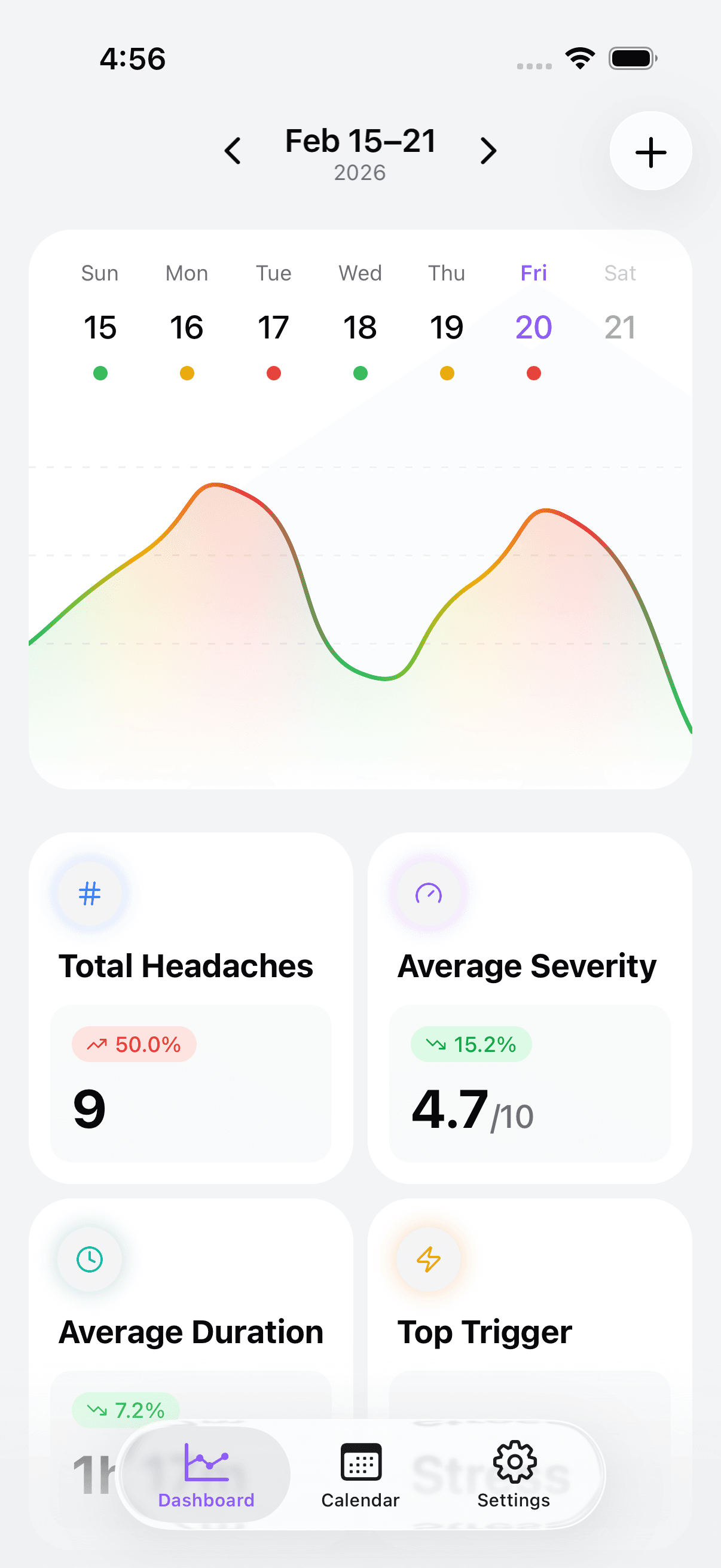
The two things that help most with triptans are timing and counting. Take your triptan early in the attack, and keep a simple record of each one: when it started, what you took, and whether it worked. After a few attacks you'll know whether your triptan is doing its job, and you'll see straight away if your medication days are creeping toward the overuse limit. Headache & Migraine Diary lets you log each headache in seconds, choose the medicine you took (triptan is one of the presets, and you can add your own by name), and mark whether it helped, helped a little or didn't help. The calendar then shows your headache days at a glance, which is the kind of record a doctor finds useful when deciding whether to adjust your treatment.