Emma Reed
February 25, 2026

Migraine Diary Master Guide: How to Find Real Patterns and Reduce Surprise Headache Days
If your headache days feel random, you’re not imagining it—they feel random when patterns are hidden. A migraine diary helps you turn scattered memories into structured data. Once you can see what happened before, during, and after attacks, decisions get easier: what to change, what to keep, and what to discuss with a clinician.
This guide is built for practical use, not theory. You’ll get a complete framework for logging, reviewing trends, and using your data without overcomplicating your life.
Important: This article is informational only and not medical advice. If headaches are new, severe, worsening, or associated with concerning symptoms, seek professional care.
Why memory fails (and diaries work)
Most people remember the worst pain days and forget the low-pain or no-pain days. That creates two problems:
- Recency bias – yesterday feels more important than last week’s trend.
- Severity bias – dramatic episodes dominate your memory.
A diary fixes both by creating daily snapshots. Even short entries matter. Over 2–4 weeks, small details become visible patterns.
What to track every day (minimum effective dataset)
If you track too many fields, you quit. If you track too few, insights stay weak. Start with this core set:
- Pain intensity: 0–10 scale
- Start and end time: or approximate windows
- Headache type notes: migraine-like, tension-like, unknown
- Symptoms: nausea, light sensitivity, sound sensitivity, aura, neck pain
- Sleep: total hours + sleep quality (good/fair/poor)
- Stress level: low/medium/high
- Hydration: rough estimate (low/okay/good)
- Caffeine: amount and time
- Meals: normal timing vs delayed/skipped
- Medication used: name, dose, time, and response
That’s enough to find useful patterns without burning you out.
What makes a “good entry” vs a “perfect entry”
Perfection kills consistency. You don’t need perfect data to get better outcomes.
Good entry (keep this habit)
- Pain score
- Time window
- One trigger clue (sleep/stress/meal/hydration)
Perfect entry (nice, but optional)
- Full symptom profile
- Detailed medication response window
- Environmental/context notes
If you miss details, still log the day. A partial entry is better than an empty day.
The 14-day startup protocol
Use this when restarting tracking or onboarding for the first time.
Days 1–3: Build rhythm
Focus on quick daily logging. Don’t analyze yet.
Days 4–7: Add context
Include sleep quality, stress, and meal timing consistently.
Days 8–10: First review
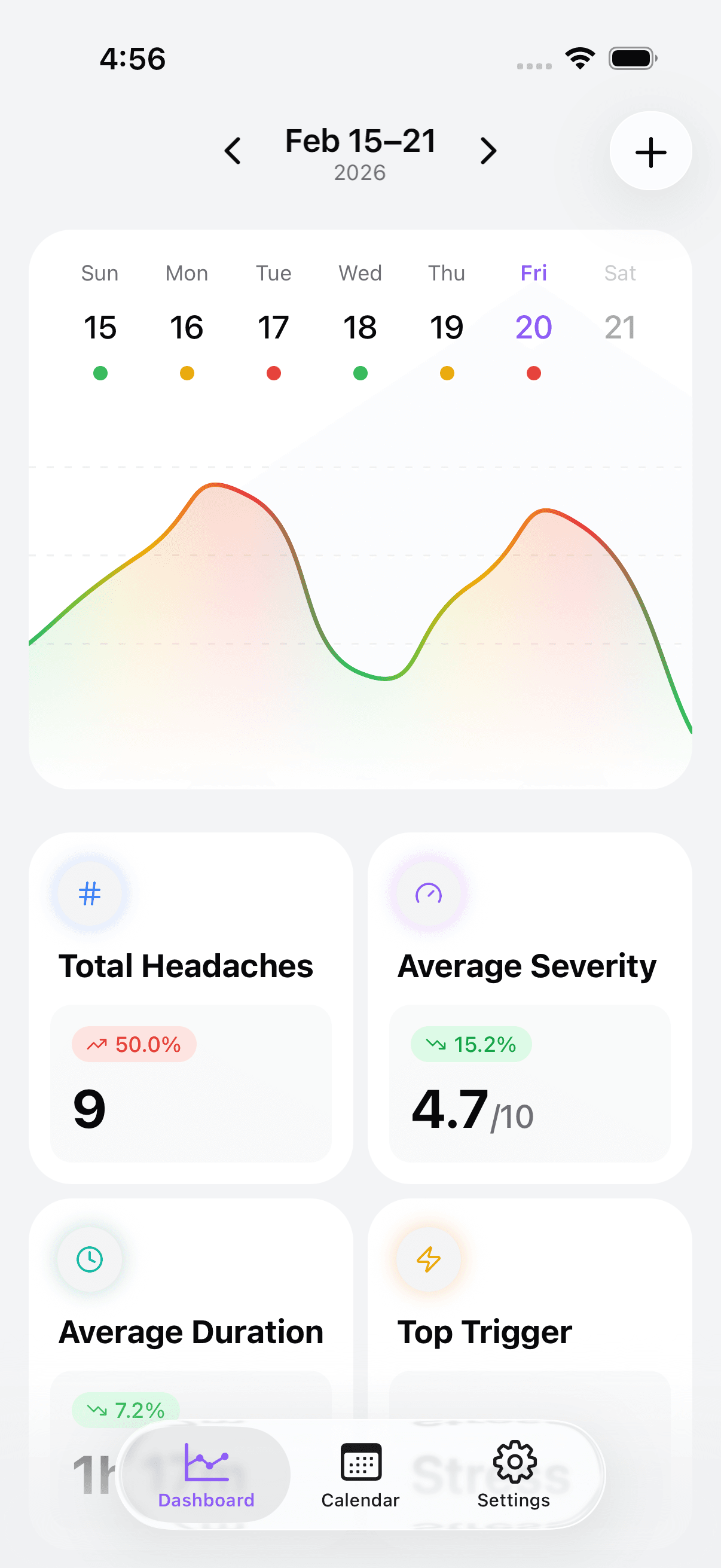
Check your dashboard trend line and pain frequency.
Days 11–14: Pattern check
Use calendar heatmap + timeline:
- Do high-pain days cluster after short sleep?
- Are attacks more common after delayed meals?
- Is stress preceding pain spikes?
- Are medication-use days becoming more frequent?
At day 14, pick one behavior change to test for the next week.
How to read trend lines without fooling yourself
Not every coincidence is a trigger. Use this simple rule: a factor is likely relevant if it appears before symptoms multiple times, not just once.
Stronger evidence pattern
- Similar exposure (e.g., <6h sleep)
- Similar outcome (moderate/high pain)
- Repeated across several days or weeks
Weaker evidence pattern
- One isolated bad day
- Many possible confounders
- No repeat sequence
Treat your diary like hypothesis testing, not verdicts.
Common trigger categories to watch
You are not trying to find every trigger at once. Start with high-yield categories:
- Sleep variability
- Meal timing and glucose dips
- Hydration and caffeine pattern
- Stress load and recovery gap
- Hormonal cycle timing (if relevant)
- Medication pattern
Medication logging: make it clinically useful
Use this structure:
- Medication name
- Dose
- Time taken
- Pain before dose
- Pain 2 hours after dose
- Side effects
Over time, this shows what helps, what helps late, and what doesn’t help reliably.
Reducing logging fatigue
Practical anti-fatigue setup
- Log at the same time daily
- Use quick tags (sleep-low, stress-high, meal-late)
- Keep entry target at 30–90 seconds on normal days
- Use reminders to prevent blank days
When to write longer notes
- First day of a new symptom pattern
- Unusually severe day
- Medication response changed unexpectedly
Weekly review template (10 minutes)
- Count pain days (mild/moderate/severe)
- Check average pain trend (up/down/flat)
- Identify top 2 repeated preconditions
- Review medication-use frequency
- Set one change for next week
Examples of one-week changes:
- Consistent wake time ±30 min
- No skipped lunch
- Hydration target by noon
- Stress decompression block in evening
Monthly review template (20 minutes)
At month-end, review:
- Headache-day count trend vs previous month
- Severe-day count
- Days with strong functional impact
- Medication-use trend
- Trigger patterns with highest repeat value
Then decide what to continue, stop, and discuss with your clinician.
Use your data in medical appointments
Bring summaries, not raw chaos:
- Average headache days/month
- Number of severe days
- Typical symptom profile
- Top repeated trigger candidates
- Medication response summary
- Recent changes that improved/worsened outcomes
Mistakes that make diaries useless
- Logging only bad days
- Changing too many things at once
- No review habit
- Inconsistent scales
- Skipping medication timing details
When to escalate care
- Pattern changes significantly
- Attacks become more severe/frequent
- New unusual symptoms appear
- Daily function declines despite consistent self-management
Closing
The goal is not perfect tracking. The goal is fewer surprise headache days and better decisions. Start simple, stay consistent, review weekly, and let patterns emerge over time.
If you use Headache Tracker daily—even briefly—you’ll get a clearer picture of good days vs bad days, likely triggers, and what management steps are actually helping.
Take control of your headaches. Start tracking today.